
There's nothing more frustrating than hearing your air tools lose pressure mid-job, or watching production slow down because your compressor can't keep up. It's a problem that tends to sneak up on business owners and operation managers; one day everything's fine, and the next you're constantly waiting for your tank to rebuild pressure.
From automotive service centers to machine shops, fabrication facilities to woodworking operations, if your business depends on compressed air, you've probably experienced this. The real question is: what's causing it, and when does it make sense to upgrade? Keep reading to get the answers you're looking for.
The Air Compressor That “Used to Be Fine”
Most facilities don’t start with a rotary screw industrial air compressor. They start with a piston (reciprocating) air compressor unit because it fits the space, the budget, and the workload at the time.
And it works, for a while.
But over time, something changes. The air compressor that once cycled on and off now seems to be running most of the day. Pressure drops show up at the worst times, and unplanned maintenance becomes more frequent. But that's not all, energy bills creep higher even though production hasn’t doubled.
This is a common transition point many organizations face, especially those that rely on compressed air for daily operations, not just occasional tool use. The issue is rarely the brand or the age of the compressor. It’s that the application has outgrown reciprocating technology.
Why Piston Air Compressors Struggle in High-Demand Applications
The main reason why many businesses encounter compressed air problems is that reciprocating air compressors are built for intermittent demand. They are not designed to support continuous airflow over long operating hours.
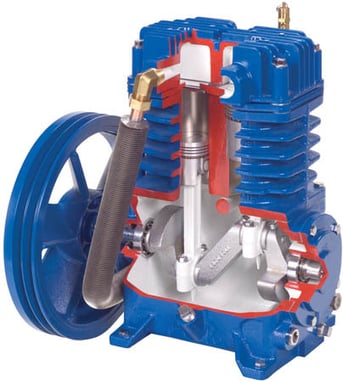 As air usage becomes more consistent, several limitations surface:
-
Frequent starts and stops stress motors and electrical systems
-
Heat buildup shortens component life
-
Pulsing airflow causes pressure instability
-
Maintenance intervals get shorter, not longer
Many organizations try to compensate by adding storage tanks or running the compressor harder. That approach keeps production moving in the short term, but it accelerates wear and increases operating cost.
At this stage, the compressor isn’t just supplying air. It’s becoming a reliability risk.
How Rotary Screw Compressor Transform Daily Operations
Rotary screw compressors are designed to deliver air continuously and efficiently. Instead of compressing air in strokes, they provide a smooth, steady flow that matches real production needs.
For facilities using compressed air systems to run tools, CNC machines, automation, or air-driven processes, that difference is noticeable immediately.
Rotary screw compressor benefits include:
-
Consistent pressure at every drop
-
Lower operating temperatures
-
Fewer starts per hour
-
Quieter operation in tighter spaces
The result is compressed air that behaves like a utility, not a variable.
Compressed Air Energy Costs Matter More Than You Think
Energy is often the largest lifetime cost of an air compressor. Reciprocating compressed air units operating near their duty cycle limits are inefficient by design. Each restart draws high amperage, and unloaded run time wastes power.
Rotary screw compressors operate more efficiently under sustained demand. With modern controls, output can follow actual air usage instead of running at full capacity all day.
For many businesses, the shift to rotary technology delivers:
-
Lower monthly energy consumption
-
Reduced electrical strain on the facility
-
Better control of operating costs as production grows
This is especially important in operations where margins are tight and downtime is expensive.
Maintenance Predictability Becomes a Competitive Advantage
Unplanned air compressor downtime usually happens when air demand is highest. That is not a coincidence. Reciprocating compressors operating outside their ideal range tend to fail suddenly and require immediate attention.
Rotary screw systems are designed for planned service. Maintenance intervals are predictable, access points are straightforward, and service can be scheduled around production.
That predictability means:
-
Fewer emergency repairs
-
Less disruption to daily operations
-
Longer equipment life
-
More confidence in air supply
For organizations without a dedicated maintenance department, this makes a significant difference.
Signs Your Operation Is Ready to Upgrade
If your workers or managers have started to notice these signs, it can be an indication that your industrial air compressors are in need of an upgrade:
-
Your compressor runs most of the workday
-
Air demand stays steady across shifts
-
Pressure drops affect tools or equipment performance
-
Maintenance costs keep increasing
-
You’re adding machines or planning future growth
When compressed air becomes critical to keeping work moving, the system and design needs to match that responsibility.
A Compressed Air Upgrade Is About the System, Not Just the Machine
Replacing a piston compressor with a rotary screw unit is not just a swap. Air storage, dryers, filtration, controls, and layout all affect performance and reliability.
At Rasmussen Air and Gas Energy, we approach upgrades by looking at how your organization actually uses air, not just the size of the old air compressor system.
Our evaluation includes:
-
Measuring real airflow demand
-
Selecting controls that fit usage patterns
-
Managing moisture and contamination
-
Designing for growth without overspending
The goal is to deliver reliable air without unnecessary complexity or excess capacity.
Compressed Air Should Not Be a Daily Concern
When properly designed, a compressed air system fades into the background. Tools work when they need to. Machines run when they should. And air pressure stays stable throughout.
If your current industrial air compressor requires constant attention just to keep up with daily operations, it may be time to move beyond reciprocating technology.
The right rotary screw system does not just replace equipment. It removes compressed air as a constraint on your operation. That is the upgrade most facilities are really looking for.
Ready to Upgrade Your Compressed Air System?
Every operation is different, and cookie-cutter solutions won't support long-term demands. Whether you need help sizing a new system, upgrading from a reciprocating compressor to a rotary screw compressor, or optimizing your existing setup, Rasmussen Air and Gas Energy is here to help. Our team can assess your current setup and recommend a custom-engineered solution that delivers the performance and reliability your organization needs.
Let's talk about your compressed air challenges and find the system that works for you.
Rasmussen Air and Gas Energy manufactures, rents, sells and repairs industrial air compressor systems and compressed gas equipment. We are your trusted partner in configuring and supporting your compressed air and gas needs across diverse industries, including food and beverage, healthcare, general manufacturing, and agriculture. As an add-value company, we leverage our knowledge, skilled team, and resources to help you succeed, offering a comprehensive range of products, services and engineered solutions designed to keep your facility operations running.