Overhauling a Critical Centrifugal Compressor for a Major Tire Supplier
Case Study Summary
When a major oil and gas company in the Rocky Mountain region faced environmental fines and high labor demands due to an inefficient oil and water separation process, they needed a more dependable approach.
Rasmussen Air & Gas Energy custom-engineered a proprietary, industrial compressor and evaporator technology solution. After a successful three-month pilot, the solution was deployed across approximately 350 well sites, saving an estimated 48 labor hours per week and eliminating further environmental fines.
Facility Overview
A major oil and gas company operates a large network of well sites in the Rocky Mountain region, specifically in Colorado. Across these distributed operations, ensuring safe, efficient production and maintaining strict environmental performance are critical operational priorities.
The Challenge
Excessive Manual Labor
The company was using a legacy oil and water separation application that required frequent manual attention at its Colorado well sites. Personnel were required to visit the installations approximately every other day to inspect the equipment and manually empty the compressed air and gas systems' collection containers.
Environmental & Regulatory Risks
Because the operation spanned a large, distributed field, that routine created a significant manpower requirement. More importantly, if a collection container check was missed and was not emptied, oil could overflow and reach the ground.
This created environmental concerns and regulatory exposure. The company had received fines associated with these incidents and needed a better way to manage the application.
Need for Strategic Solution
The challenge was not simply replacing a piece of equipment. The company needed to reduce the recurring burden of field labor while creating a more dependable method for managing oil and water and reducing the risk of environmental releases.
The Solution
An Idea Takes Shape
The customer expressed frustration with repeatedly sending staff into the field to check the existing systems. During the conversation, a practical question emerged: What if the collected liquid could be handled differently to reduce the need for extensive manual intervention?
Rasmussen Air & Gas Energy recognized an opportunity.
The Rasmussen team, having experience with evaporator technology and complex compressed gas systems, applied a concept adapted to the customer's application. What began as an informal discussion quickly became an engineering project focused on solving a specific field problem.
Custom Engineering a Better Approach
The objective was straightforward: reduce the need for repeated manual handling while creating a safer and more reliable process for managing the separated liquids.
Rather than simply modifying the existing equipment, the Rasmussen Air & Gas Energy team built a solution designed specifically around the customer's actual operating process and industrial field environment.
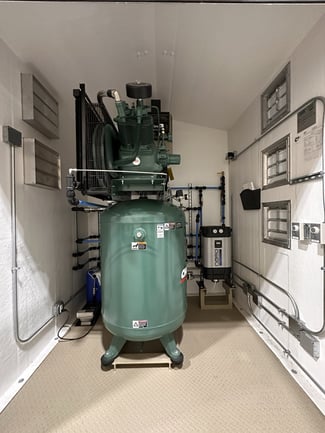
A Rasmussen Air & Gas Energy engineer developed a redesigned oil and water separator application incorporating a custom evaporator. The system also included a specialized safety cover and other application-specific considerations required for use at the customer's well locations.
Because Rasmussen Air & Gas Energy considers the specific design proprietary, detailed system specifications and equipment configurations are not disclosed.
The project's value lies in the engineering process: understanding how the customer was actually using the equipment, identifying the operational burden, and designing a practical solution around the real-world application.
Proving the Solution in the Field
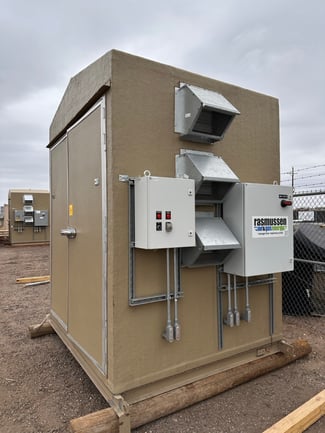
To prove the concept, Rasmussen Air & Gas Energy supplied a custom-engineered setup for a field trial at a single well site.
The pilot operated for approximately three months, allowing the customer to evaluate the concept under actual operating conditions. Rasmussen Air & Gas Energy also presented the system to customer leadership, demonstrating the simplicity of the design and how it addressed the recurring problem.
The concept initially appeared almost too simple to solve an issue that had for so long created such a persistent burden, but the field trial provided the necessary proof. Some locations required electrical upgrades to accommodate the new application, but after the pilot demonstrated its effectiveness, the customer moved forward with a broader deployment.
Expansion from 1 Site to 350 Systems
Following the successful pilot, what began as a single engineered solution expanded to approximately 350 systems deployed at tank battery locations near the customer's well sites.
That scale is an important part of the story.
Although Rasmussen Air & Gas Energy did not begin with a predetermined rollout of hundreds of units, the solution earned the larger deployment by solving the problem at one location first and showing the concept could be repeated across a distributed oil and gas operation.
A problem identified during an informal discussion ultimately became a repeatable engineered solution used across hundreds of locations. The project illustrates the value of designing for the customer's operating environment rather than forcing an existing product into the application.
The Results
Labor Savings
The redesigned application significantly reduced the manual burden associated with the customer's previous process.
The new application saves an estimated 48 labor hours per week previously required to check the systems across the company's operations.
Cost Reductions
Reducing those field visits carries value beyond the labor hours alone.
By eliminating the need for routine manual inspections at remote oil and gas locations, the company substantially reduced costs associated with vehicle time, travel, labor, and other field expenses.
Additionally, reducing the frequency of routine inspections allows those resources to be directed toward higher-value operational work.
Eliminated Fines
The environmental outcome was equally important.
By addressing the conditions that had allowed oil to reach the ground when the previous systems were not serviced as required, the new application reduced the potential for those releases.
According to the information provided for this case study, the customer has experienced no further fines associated with this issue following the deployment of the new compressor systems.
Engineering Around the Application
This project demonstrates an important principle behind Rasmussen Air & Gas Energy's approach to engineered solutions for compressed air and gas: the right answer does not always begin with an existing product.
It begins with understanding the application.
By examining the customer's operating process, field labor requirements, environmental risks, and equipment limitations, Rasmussen Air & Gas Energy developed an engineered solution specifically around the problem.
The result was a concept that could first be proven at one location and then replicated across approximately 350 installations.
For industrial operators facing persistent compressed air equipment, process, labor, reliability, or environmental challenges, Rasmussen Air & Gas Energy brings strategic engineering experience and practical problem-solving to applications where an off-the-shelf solution may not be enough. As a leader in industrial compressed air and gas, the team is dedicated to designing around the customer's actual problem.
Reach out to speak with a compressed air expert about your compressed air and gas system today.