
When a centrifugal air compressor operates for 20 to 30 years, it inevitably transitions from a reliable system to a daily maintenance challenge. Plant managers and engineers begin to deal with frequent efficiency drops, obsolete spare parts become difficult to source, and the risk of needing emergency compressor repair grows by the day.
As a result, this question becomes unavoidable:
Do you repair the machine, perform a full overhaul, install a remanufactured compressor, or replace the system entirely?
At first glance, this appears to be a mechanical decision. In reality, it is a financial, operational, and strategic one. And many facilities underestimate what is actually involved when refurbishing an aging compressor.
One of the most common misunderstandings facilities make when evaluating this choice is assuming the airend alone determines the compressor's health. In reality, a centrifugal compressor relies on five critical, interdependent systems, and failing to evaluate all of them can lead to costly capital mistakes.
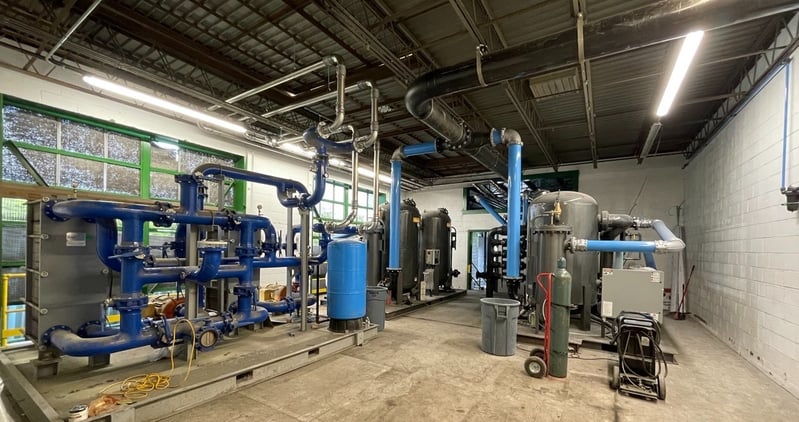
The 5 Critical Systems in an Industrial Air Compressor
When evaluating overhaul or refurbishment, it’s important to understand that an industrial air compressor is not a single component. It is a system made up of five major subsystems that must all function properly for the machine to operate efficiently and reliably.
1. Compression System (Airend and Impellers)
This is the component most people focus on.
It includes:
-
Impellers
-
Diffusers
-
Shafts
-
Bearings
-
Seals
If these components degrade, airflow and efficiency decline. However, rebuilding the airend alone does not guarantee the compressor will perform properly.
2. Lubrication System
Bearings, gears, and rotating assemblies rely on stable lubrication.
Aging compressors often experience:
-
Oil contamination
-
Pump degradation
-
Filter and separator inefficiencies
-
Temperature control issues
Neglecting the lubrication system during a rebuild can significantly shorten the lifespan of a newly refurbished airend.
3. Cooling System
Heat exchangers and intercoolers are essential to maintaining proper operating temperature and efficiency.
What happens over time:
-
Tubes foul
-
Scaling occurs
-
Heat transfer declines
Reduced cooling efficiency leads to increased energy consumption and places additional stress on internal components.
4. Controls and Electrical Systems
Many compressors installed 20 to 30 years ago operate on obsolete control platforms.
Issues commonly include:
-
Unsupported PLC systems
-
Analog controls
-
Limited monitoring capability
-
Poor system integration
Modern controls improve reliability, diagnostics, and overall system efficiency. When considering refurbishment, control system modernization should be part of the discussion.
5. Structural and Mechanical Systems
The final piece often overlooked includes:
-
Base and structural components
-
Couplings and drive assemblies
-
Vibration isolation
-
Mounting and alignment
Mechanical wear in these areas can lead to vibration issues, bearing damage, and reliability problems even after a rebuild.
The Hidden Costs of Delayed Industrial Air Compressor Service
 Many facilities default to repair because it feels like the least expensive option. However, this short-term thinking can mask long-term cost exposure.
Maintenance Escalation
As compressors age, maintenance trends typically show:
• Increasing bearing wear
• Seal degradation
• Cooler performance loss
• Control system failures
Emergency repairs become more frequent, and teardown costs become less predictable. Implementing preventive maintenance for the compressed air system earlier can mitigate some of these issues, but, again, infrastructure eventually requires a larger intervention.
Energy Inefficiency
Energy is the largest cost associated with operating a compressor.
In fact, electricity typically accounts for 90 to 95 percent of the total lifecycle cost of motor-driven equipment. This is why compressed air is often referred to as the fourth utility, alongside electricity, water, and natural gas.
When accounting teams understand compressed air this way, it becomes easier to justify investments that reduce operating costs rather than simply minimizing capital spending. Even small efficiency losses can result in tens or hundreds of thousands of dollars in wasted electricity per year.
Production Risk
The true cost of compressor failure goes beyond just the repair bill.
It involves so much more, including lost production, overtime labor, expedited freight, missed delivery commitments, and even customer penalties. In high-throughput manufacturing environments, downtime can result in losses of thousands of dollars per hour.
Centrifugal Compressor Repair vs. Overhaul, Remanufacture or Replace
Each path can be valid depending on the machine condition and facility constraints. The key is understanding the scope of work and long-term economics.
Repair vs. Overhaul vs. Remanufacture vs. Replace
| Repair | Overhaul | Remanufacture | Replace |
|
Scope:
|
Scope:
|
Scope:
|
Scope:
|
|
Advantages:
|
Advantages:
|
Advantages:
|
Advantages:
|
|
Tradeoffs:
|
Tradeoffs:
|
Tradeoffs:
|
Tradeoffs:
|
| Repair can extend life. It rarely resets lifecycle. | Overhaul improves condition. It may not improve performance. | Remanufacturing reduces uncertainty and downtime variability. | Replacement enables modernization. It also creates opportunity for system optimization. |
Centrifugal Compressor Repair:
Repair typically involves targeted component replacement, such as bearings, seals, coolers, and minor impeller work. Advantages include lower immediate cost and shorter downtime. However, repair rarely resets the machine's lifecycle and may leave other aging systems untouched.
Centrifugal Compressor Overhaul:
An overhaul is a more comprehensive mechanical rebuild that includes bearing and seal replacement, inspection and rebalancing, impeller refurbishment, and component inspection across multiple systems. This approach can significantly improve reliability, but energy efficiency may still lag behind that of modern equipment.
Remanufactured Compressor:
Remanufactured compressors are rebuilt to original specifications and tested in a controlled environment. Advantages include predictable costs, factory-level testing, reduced field risk, and, in many cases, faster delivery than new equipment. However, installation logistics and system compatibility must still be evaluated.
Replace with New Equipment:
Full replacement provides modern efficiency improvements, advanced controls and monitoring, lower long-term maintenance requirements, and potential capacity right-sizing. The tradeoff is higher capital investment and longer lead times.
Find out more about: Engineered Compressor Systems That Deliver Results
Financial Reality: Budgeting for Industrial Compressed Air Systems
Another major challenge in compressor decision-making is how the investment is presented internally. While maintenance and operations teams often understand lifecycle cost, capital approval typically involves finance or accounting teams that focus heavily on upfront cost.
Operating expense projections are sometimes viewed as less certain than capital expenditures, which can lead decision-makers to choose the lowest initial cost option. This is why presenting compressed air as the fourth utility is so effective. Once leadership understands that air production has a measurable operating cost just like electricity or water, lifecycle modeling becomes easier to justify.
How to Know When Refurbishment Is the Right Move
If you are still unsure about the best option for your facility, a practical guideline can help when evaluating refurbishment. If a complete system refurbishment can be completed for approximately 60 percent or less of the cost of new equipment, it may be the most practical choice.
This is especially true when considering the hidden costs of full replacement, including:
• Removing existing equipment
• Structural modifications
• Piping and electrical reconfiguration
• Space constraints within the compressor room
• Production disruption during installation
In many plants, compressors were installed before surrounding equipment or structural modifications were made. Removing and replacing a unit can often demand significantly more effort than initially anticipated. Refurbishing the existing compressed air system can help avoid these logistical challenges while restoring reliable operation.
Why System Evaluation Matters First
One of the most common mistakes is evaluating the compressor in isolation. The correct starting point is a compressed air system assessment.
Our full system audit evaluates:
|
Supply Side • Output vs demand • Load patterns • Redundancy strategy |
Demand Side • Leak load • Artificial demand • Process changes |
Distribution System • Pressure drop • Storage capacity • Dryer and filtration performance |
A proper analysis often reveals that the issue is not just the compressor itself, but how the entire air system operates.
Decision Framework
Before committing to repair, overhaul, remanufacture, or replacement of your industrial compressed air system, consider the following:
-
What is the compressor’s current efficiency compared to original performance?
-
Are maintenance costs increasing year over year?
-
What is the cost of downtime per hour?
-
Are the control systems obsolete?
-
Has system demand changed?
-
What is the true lifecycle cost of each option?
If these questions are being answered with assumptions rather than measured data, the first step should be a system analysis to give clarity on the right path forward for your compressed air system.
Data-Driven Decisions for Air System Energy Optimization
An aging centrifugal compressor does not automatically mean replacement. But rising maintenance costs, declining efficiency, and increasing downtime risk should not be ignored.
The right decision depends on:
• Mechanical condition
• System role
• Energy economics
• Production risk
• Capital strategy
At Rasmussen Air & Gas Energy, we help facilities quantify these variables through on-site analyses of industrial compressed air systems that measure performance, efficiency, and operational risk. If your centrifugal compressor is showing signs of age, the smartest next step is not guesswork. It is a data-driven evaluation that compares repair, overhaul, remanufacture, and replacement options with clear financial modeling. Decisions backed by data reduce risk, control cost, and protect production continuity.
Discuss Your Options With Our Expert Team
Don't wait for a costly failure or make decisions without weighing your options. Contact our expert team of compressed air engineers at Rasmussen Air & Gas Energy today to discuss your system and find the right path forward for your facility.
Rasmussen Air and Gas Energy manufactures, rents, sells, and services industrial air compressor systems and compressed gas equipment. We support food and beverage, healthcare, manufacturing, agriculture, and other energy intensive industries with engineered compressed air system design, deployment, and lifecycle solutions that maximize productivity and manage flow for measurable financial performance.