Preventing Compressor Bearing Failures with Motor Shaft Grounding
Facility Overview
An asphalt production facility required a natural gas compression solution to support a critical burner system. To ensure seamless, continuous operation, the plant needed a partner experienced in custom industrial compressed air and gas system design.
The Challenge
Increased Demand and Insufficient Utility Pressure
The pressure of utility-supplied natural gas was inadequate to meet the burner demand, requiring compression to 35 psig at the burner inlet.
Key project constraints included:
-
Variable and unpredictable burner flow demand, especially during high-fire operation
-
A 3,000-foot line pack already in place, with uncertainty on optimal compressor placement
-
Hazardous area requirements (Class I, Division 2)
-
Extreme outdoor operating conditions
-
An aggressive 12-week timeline to achieve operational readiness
The customer needed an engineered solution that balanced flexibility, speed, and reliability, without committing to a rigid or overbuilt system that could limit future site configurations.
Engineering Considerations
Rasmussen Air & Gas Energy began the engagement by evaluating multiple system-level variables rather than forcing a one-size-fits-all compressor selection.
Key considerations included:
-
Positioning the industrial compressor either upstream or downstream of the existing line pack
-
Designing to accommodate a range of flow capacities rather than just a single design point
-
Managing transient high-flow events during burner high-fire cycles
-
Minimizing pressure drop and response lag across long piping runs
-
Ensuring compliance with hazardous area classifications
-
Reducing startup risk under a compressed project schedule
From there, a team of engineers applied their extensive expertise to begin designing an industrial compressor system to optimize every component for the specific environmental demands. Rather than focusing solely on compressor horsepower, Rasmussen Air & Gas Energy engineered the system based on actual operating behavior, recognizing that burner demand profiles are rarely static in asphalt applications.
The Custom-Engineered Solution
Rasmussen Air & Gas Energy provided a complete natural gas compression system that is designed to meet immediate needs while remaining adaptable for future requirements and additional installations.
The solution included:
-
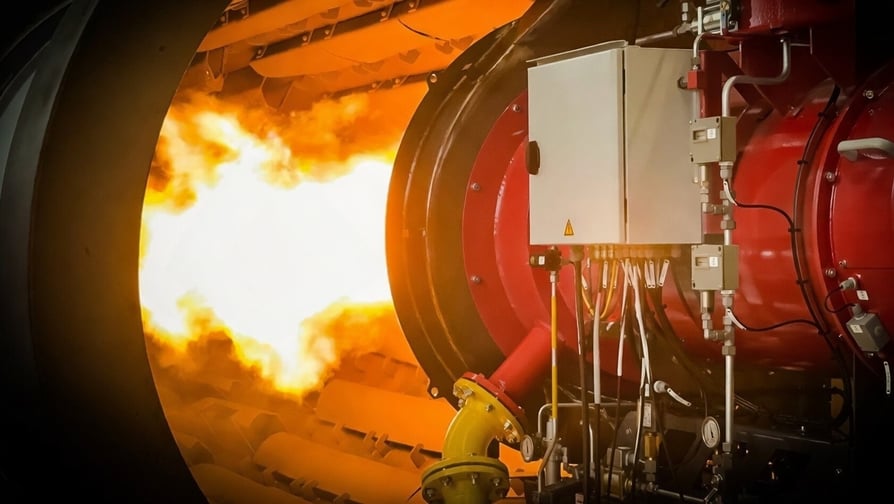
A highly efficient LeRoi natural gas rotary screw compressor system, sized at 200 HP
-
Designed and rated for Class I, Division 2 environments
-
Variable Frequency Drive (VFD) control to manage fluctuating flow demand
-
Integrated gas receiver storage paired with inline filtration and separation solutions to support high-fire events without pressure instability
-
Fiberglass equipment enclosure to protect against extreme weather and improve system longevity
To meet the 12-week deadline, Rasmussen Air & Gas Energy acquired a slightly used compressor package and made targeted modifications to align it with the application requirements. This approach reduced lead time significantly while ensuring performance, safety, and reliability.
Importantly, the system architecture was specifically designed to allow the natural gas compressor package to be replicated as a new build for future sites, enabling standardization across multiple asphalt facilities.
The Results
Speed to Operation
By leveraging existing equipment and performing focused engineering modifications, Rasmussen Air & Gas Energy met the aggressive startup timeline without compromising system integrity.
Operational Flexibility
The combination of VFD control and receiver storage allowed the system to handle a wide operating envelope, accommodating variable burner demand rather than forcing operators into narrow control limits.
Reduced Risk
The packaged, enclosed solution minimized on-site integration risk and exposure to weather-related failures, improving long-term uptime.
Scalability
The system design can be replicated or adapted for other asphalt plants with similar gas supply challenges, supporting fleet-wide deployment strategies.
Why This Matters for Asphalt Producers and Utilities
Asphalt burner applications frequently experience performance issues when systems are designed for only average flow conditions. This can lead to inefficiencies and failures, since it does not account for the variability in flow rates that can occur during operation. For asphalt producers and utilities, understanding the importance of sizing systems for peak flow scenarios is essential to maintaining reliable performance and optimal efficiency.
Rasmussen Air & Gas Energy approaches these projects by:
- Designing for transient demand, not just steady-state operation
- Viewing compression, storage, and controls as a unified system
- Balancing capital efficiency with operational resilience effectively
- Delivering solutions that function under real-world constraints
This strategy minimizes commissioning risk, improves burner performance, and shortens the path from engineering approval to production.
Talk to Rasmussen Air & Gas Energy
If you are evaluating a natural gas compression solution for an asphalt burner, or need support navigating pressure limitations, hazardous area requirements, or tight project timelines, Rasmussen Air & Gas Energy can help.
Whether you need complex engineering, emergency compressor repair, or a complete compressor system quote for your facility, our cross-functional expertise ensures your operations are always running optimally.
Contact Rasmussen Air & Gas Energy to start an engineering-driven discussion focused on reliability, flexibility, and long-term value.