When a Desiccant Dryer Is the Right Choice for Your Facility
Choosing the right air dryer for your industrial compressed air system can have a big impact on everything from reliability and efficiency to overall operational performance. But with refrigerated and desiccant dryers offering different benefits, how do you know which one is the right fit for your application?
The answer depends on several factors like the proper dew point for your facility, operating environment, air quality needs, and how your compressed air is used in your industry. In this guide, we'll break down the key differences between refrigerated and desiccant air dryers to help you determine which one makes the most sense for your system.
Why Your Compressed Air System Needs a Dryer
Moisture is unavoidable in compressed air. Atmospheric air naturally contains water vapor, and when that air is compressed and cooled, moisture condenses. If it is not properly controlled, this moisture can contribute to corrosion, pneumatic equipment failures, product quality issues, process contamination, and freezing in exposed piping.
That makes choosing the right air dryer for your industrial compressed air systems a critical decision for your facility.
Two of the most common options are refrigerated and desiccant air dryers. Both remove moisture, but they provide different levels of drying, operating costs and maintenance requirements.
The decision ultimately starts with one fundamental question:
How dry does your compressed air actually need to be?
Choosing the Right Dryer For Your Compressed Air System
Start With Pressure Dew Point
Pressure dew point (PDP) is the temperature at which water vapor in compressed air begins to condense into liquid water at your system's operating pressure. Simply put, the lower the pressure dew point, the drier the compressed air.
While a compressed air system that produces approximately 38°F PDP air contains more water vapor than one producing minus 40°F PDP air, that does not automatically make minus 40°F air better. Producing air that is significantly drier than the process requires can increase equipment cost, energy consumption, and maintenance without improving production.
The objective is to produce air that is precisely dry enough for the application, not more and not less.
When to Choose a Refrigerated Air Dryer
A refrigerated dryer cools compressed air so water vapor condenses into liquid, which is then separated and drained before the air enters the distribution system. These dryers commonly produce pressure dew points in the mid-to-upper 30°F range.
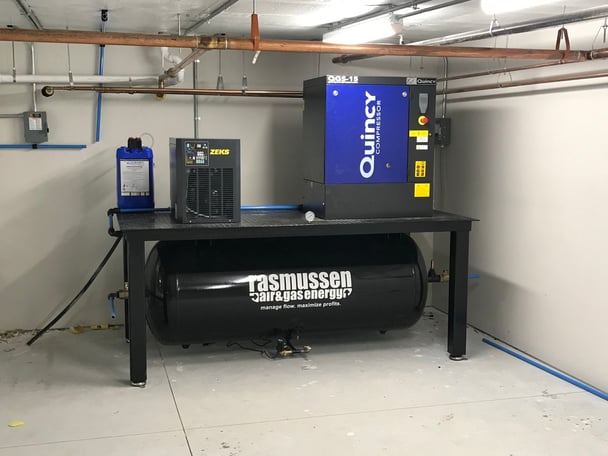
Refrigerated drying provides straightforward operation and maintenance, making them well-suited for:
-
General manufacturing and plant air
-
Pneumatic tools and equipment
-
Indoor compressed air piping maintained above freezing
-
Processes without extremely low moisture requirements
For many industrial facilities, refrigerated drying provides the necessary moisture control with relatively straightforward operation and maintenance.
One important consideration for plant managers and maintenance engineers is the lowest temperature that compressed air will encounter downstream. If piping travels outdoors, across rooftops, or through unheated areas where temperatures fall below the air's pressure dew point, additional condensation will occur. In these scenarios, a refrigerated dryer may not provide sufficiently dry air.
When to Choose a Desiccant Air Dryer
Desiccant dryers use an adsorbent material to remove water vapor. Many regenerative designs use two desiccant towers: one dries the compressed air while the other regenerates, alternating in cycles.
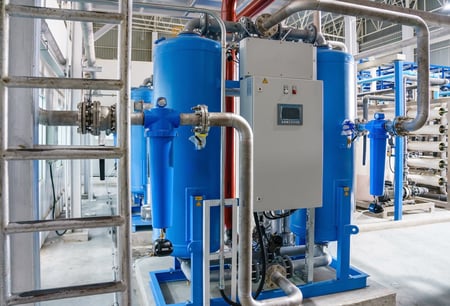 Desiccant dryers can achieve much lower pressure dew points than refrigerated dryers. A common industrial design point is approximately minus 40°F PDP for the pressure dew point, although other dew points are also achievable.
Desiccant technology is often appropriate for:
-
Piping exposed to freezing temperatures
-
Instrument air
-
Moisture-sensitive manufacturing processes
-
Critical process applications with stringent air quality requirement
Achieving a significantly lower dew point comes with additional operating considerations, including purge air, regeneration energy, necessary filtration, specialized controls, and higher overall system complexity.
Refrigerated vs. Desiccant Air Dryer
| Consideration | Refrigerated | Desiccant |
| Typical PDP | About 35°F to 39°F | Commonly around minus 40°F |
| Typical Application | General plant air | Very dry or critical air |
| Drying Method | Cooling and condensation | Desiccant adsorption |
| Freezing Exposure | Limited | Better suited |
| Energy Considerations | Refrigeration and pressure drop | Purge/regeneration and pressure drop |
| Complexity | Generally lower | Generally higher |
Actual performance varies by dryer design, sizing, operating conditions, and manufacturer specifications.
Calculate the Hidden Energy Costs of Purge Air
Not all desiccant dryers operate the same way. Heatless regenerative dryers use some of the already dried compressed air to regenerate the offline desiccant tower. That purge air has a direct energy cost because the compressor had to produce it.
Heated and blower purge designs use different regeneration methods that may reduce industrial compressed air consumption, but they introduce other energy requirements.
When evaluating desiccant technology, look beyond the initial purchase price and ask these critical operational questions:
-
How much purge air does the dryer require?
-
How much energy does regeneration consume?
-
Is dew point dependent control available?
-
What maintenance does the dryer require?
-
What will the dryer cost to operate annually?
For continuously operating or larger compressed air systems, these differences can significantly affect your lifecycle cost.
Related Article: Air Compressor Audit Services to Improve System Performance
Factor in Pressure Drop and System Filtration
Dryers should never be evaluated as standalone equipment.
Filters, dryers, separators, piping, and other components all contribute to pressure drop. Excessive pressure loss can lead facilities to increase compressor discharge pressure, which directly increases energy consumption.
Filtration is particularly important with desiccant dryers. Appropriate upstream air filtration protects desiccant from contaminants, while downstream filtration helps prevent desiccant particulate from entering the distribution system. The dryer, filters, drains, piping, and compressor must be viewed as one integrated air treatment system.
Does Your Entire Plant Need the Same Dew Point?
If most of your plant can operate effectively with refrigerated dried air, but one specific process requires minus 40°F PDP, drying every cubic foot of compressed air to the lowest dew point is rarely the most efficient approach.
Depending on the application, additional treatment may be applied closer to the critical process. This requires proper engineering because flow, pressure, storage, redundancy, and air quality requirements all influence the design. Treat compressed air to the quality the process requires rather than automatically drying the entire facility to the most demanding specification.
10 Questions to Ask Before Buying an Industrial Air Dryer
Before selecting refrigerated or desiccant technology, turn your dryer selection from a simple equipment purchase into an engineered system decision by determining the following:
- What pressure dew point does the process require?
- What is the lowest temperature the compressed air will encounter?
- What are the minimum and maximum airflow requirements?
- What are the inlet temperature and operating pressure?
- Does demand vary significantly?
- What air quality specifications apply?
- What are the dryer's energy and purge requirements?
- What pressure drop will the air treatment system create?
- What maintenance will be required?
- Does the application require dryer redundancy?
Match Your Air Dryer Technology to Your Application
There's no one-size-fits-all choice between refrigerated and desiccant dryers.
For many general industrial applications, a refrigerated dryer provides the required moisture control without the added cost and complexity of producing extremely dry air. However, when piping is exposed to freezing temperatures or the process requires a very low pressure dew point, desiccant technology is often necessary.
Underdrying can create moisture-related reliability and product quality problems, while overdrying can add unnecessary capital cost, energy consumption, and maintenance. You don't have to make this decision on your own. Our team of air experts at Rasmussen Air & Gas Energy evaluates compressed air treatment within the context of the entire system. This includes considering process requirements, pressure dew point, compressor capacity, filtration, pressure drop, controls, distribution, operating environment, and lifecycle costs.
Request a consultation with Rasmussen Air & Gas Energy to evaluate your compressed air quality requirements and determine the right dryer technology for your application.
Rasmussen Air and Gas Energy manufactures, rents, sells, and services industrial air compressor systems and compressed gas equipment. We support food and beverage, healthcare, manufacturing, agriculture, and other energy intensive industries with engineered compressed air system design, deployment, and lifecycle solutions that maximize productivity and manage flow for measurable financial performance.